I'll say it plainly: Most commercial inflatable water park failures aren't product failures. They're planning failures. That was a hard conclusion for me to reach.
I'm the person who signs the purchase orders at a regional family entertainment center. For seven years, I've been responsible for sourcing, cleaning, and maintaining our inflatable fleet. I've made eleven documented mistakes, totaling roughly $18,000 in wasted budget and deposits. One mistake delayed a weekend opening and forced us to refund 40 tickets. I'm not sharing this because I enjoy rehashing old embarrassment. I'm sharing it because, after three bad installs, I built a checklist that has caught 47 potential errors in the last 18 months. That checklist changed how I buy everything, including our latest water attraction.
The Product Looks Like a Trailer. That's the Problem.
Look at a Blast Zone Pirate Bay Inflatable Water Park on a screen and you'll see a polished, sunny experience. The colors pop, the splash looks refreshing, the kids look happy. It's not entirely different from watching an Uncharted video game trailer and thinking you understand the game. The trailer is real, but it's also the most edited, best-lit version of reality.
I'm not a game developer, so I didn't fully understand what it meant to build a game until I read about how to develop a video game from the production side. The core discipline isn't the trailer. It's playtesting—breaking your own work before the user does. A good developer tests every edge case, not just the main path. If we did that before placing an order, we'd avoid most of the problems I've lived through.
The First Mistake: I Bought the Trailer, Not the Operation
Everything I'd read about commercial inflatables said that if you pay for a premium build, it will be the easiest to operate. In practice, the premium build was excellent—the Blast Zone Pirate Bay Inflatable Water Park itself was well-made and survived a full season. But I had underestimated how much of the experience depends on day-to-day operations.
The catalog didn't tell me how much water pressure the slide needs. It didn't tell me how long the surface takes to dry in the shade. It didn't tell me that we'd need a second team member just to manage the entry line. So the first season was a constant fire drill. The product wasn't the problem. My expectations were.
The Second Mistake: I Ignored the Edges
I used to look at a site plan the way I looked at a microscope slide in high school biology: focus on the center, call it done. That's backwards. On a microscope slide, the interesting things are often at the edges. In a site plan, the problems live at the edges too.
The numbers said the larger water park model was the best value per square foot. My gut said we were overcomplicating the setup. I went with the numbers. The unit arrived on time and looked great. The problem showed up when we tried to install it (surprise, surprise). It fit in the cleared area, but it left only six feet of clearance on the exit side. The manual required ten feet. That mistake cost us extra anchoring, a rerouted entry path, and a weekend of delay. All because I looked at the center of the layout and ignored the perimeter.
The Third Mistake: I Trusted Claims Without Evidence
One brochure I received described a water slide as 'low maintenance.' I didn't question it. Per FTC advertising guidelines (ftc.gov), claims should be truthful and substantiated. I should have asked them to substantiate that one. I didn't. The pump failed twice in the first month.
Now my rule is simple: if you can't provide an operational manual, a service log, or a reference, the claim is just a claim. That rule has nothing to do with brand loyalty. It's about protecting the open date. I'll gladly spend 10 minutes explaining this to a customer because an informed customer asks better questions—and usually makes a faster decision.
The Fix: A Pre-Purchase Checklist
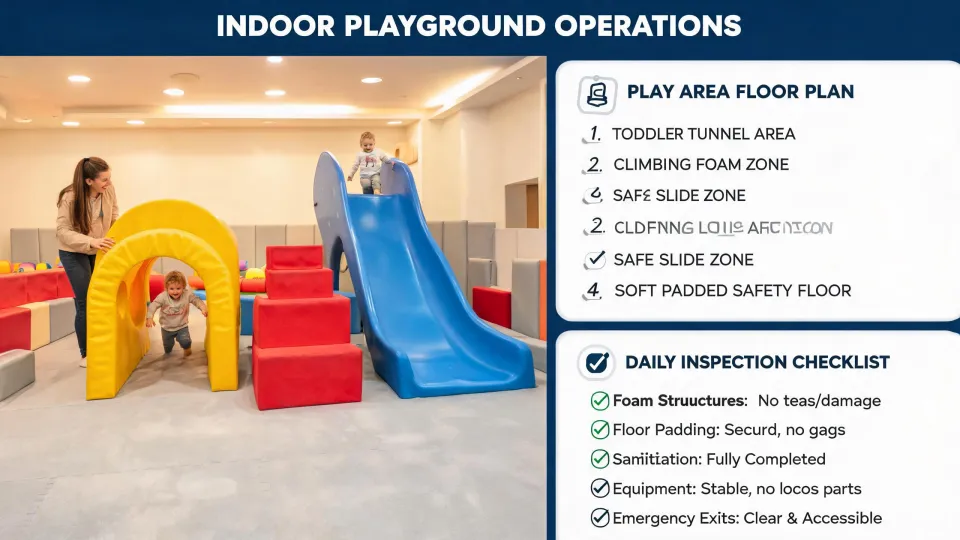
After the third mistake, I created a pre-purchase checklist. I use it for every inflatable, whether it's a small bounce unit or a large water park. The list includes:
- Water source: distance, pressure, and flow rate at the connection point.
- Drainage: where the water goes and whether the ground stays stable.
- Clearances: all sides, including overhead and exit paths.
- Storage: does the unit fit through the door and into the storage room?
- Accessories: do we have spare blowers, repair patches, and replacement tube sections?
- Operating window: how long does setup and dry-down take?
- Inspection routine: we follow the maintenance guidelines in ASTM F2376 for commercial inflatable amusement devices.
That last one is worth emphasizing. The checklist isn't a piece of paper; it's a way to test assumptions before you spend money. In the past 18 months, we've caught 47 potential errors using it. One of those was a site with an overhead power line that would have blocked the tallest slide. Another was a pump voltage mismatch that would have ruined a motor on day one.
Wait, Every Venue Is Different
I know the objection: 'Your site isn't my site. Your checklist won't fit my constraints.' Fair. But there are universal failure modes. Water goes somewhere. Wind has a speed rating. Children will run around the back of the slide. The specific measurements change, but the categories don't.
Think about the blast zone in the broadest sense: the entire area around an inflatable, including the wet floor, the waiting line, and the path to the restrooms. That zone is where injuries happen and where operational plans succeed or fail. You can't see that zone in a product photo. You have to design it yourself.
Bottom Line
I'm not saying the Blast Zone Pirate Bay Inflatable Water Park is perfect—or that any product is. I'm saying that a great unit won't run itself. It needs someone who planned the water supply, the clearances, the staffing, and the Monday-morning inspection.
The blast-zone product family is broad, and I've learned to evaluate it the same way I'd evaluate a complex video game: with the unglamorous patience of a developer, not the excitement of a player watching an Uncharted video game trailer. There's something satisfying about opening on a Saturday knowing the checklist was done. Plan the Tuesday-morning reality before you place the order. Start with the checklist, not with the render.