There's a question I get from venue owners and event planners all the time: 'Which inflatable should we buy?' And my honest answer—after four years of inspecting these things for a living—is that it depends. Not because I'm dodging the question. The right setup for a backyard rental company is different from the right setup for an indoor play center, and both are different from what a seasonal fair operator needs.
Here's the short version: there are three common scenarios. Rental startups usually need a mid-size play palace, indoor family entertainment centers need durable combo units plus a downtime plan, and large seasonal operators need a spectacle unit surrounded by workhorses. I'll walk you through each one.
For context, I'm the quality manager at a commercial inflatable manufacturer. I review about 200 units every season before they go out. In 2024, I rejected roughly 15% of first deliveries for stuff like seam tension pulling out of spec, zippers that wouldn't hold under stress, and blower connections that didn't seat properly. I've personally reviewed units that were bought for the wrong reasons.
It took me a few years and a few hundred inspections to understand that 'commercial grade' is mostly a marketing term, not a certification. Some units labeled commercial had cheaper zippers than the residential ones. So let's not pretend there's a universal answer.
Scenario 1: You're Starting an Event Rental Company
If you're building a party rental business, the biggest temptation is to buy the biggest inflatable you can afford. Maybe you're even thinking about the world's biggest bounce house as your flagship. Don't. Start with a mid-size combo unit, like the blast zone play palace bounce house.
Here's the thing about a play palace: it fits in more places. Backyards, church parking lots, school gyms, park pavilions—they all work. Plus it's easier to transport. One person can set it up with a couple of hours of practice, and it doesn't need a monster truck. In terms of revenue per square foot, the medium units consistently beat the giant ones in the rental market. Never expected that when I started. I figured bigger = more impressive = more bookings. Turns out kids don't need a ton of empty space. They need variety—a slide, a climbing wall, a bounce zone, maybe a ball pit. A play palace gives you that in one unit.
When I inspect a play palace, I look at seam tension at the anchor points, the weight of the fabric, and the blower's CFM rating. A cheap unit can look great in product photos and fail after 20 events. The blast zone play palace is one of the ones that actually lives up to the label—commercial-grade fabric and double-stitched seams at the stress points. That's where the durability shows up.
Another thing I tell rental startups: don't just think about the inflatable. Think about the full experience. Some of our most successful clients add a few tabletop games to every booking. One operator in Ohio keeps a Murdle board game and a deck of cards in every order. Parents and grandparents sit down, do murder mystery logic puzzles, and play a few rounds of Speed while the kids bounce. For anyone asking 'how do you play speed card game?' it's simple: two players, two piles of cards, and you race to play cards in ascending or descending order into a shared middle pile. First to empty their stock wins. It sounds chaotic, but that's the fun. And you don't need a full table setup—a grassy patch or a bench works fine. It costs almost nothing, and it makes your rental package look way more thoughtful.
Scenario 2: You Run an Indoor Family Entertainment Center
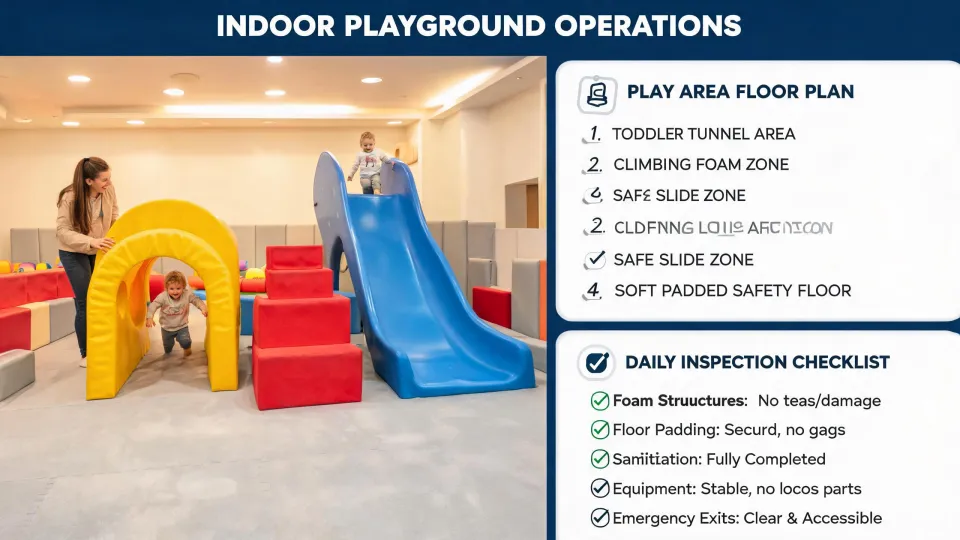
If you have a fixed venue open six or seven days a week, your priorities are different. You need durability, throughput, and low maintenance. A blast-zone Play Palace bounce house works well as the anchor of a kids' zone, especially if you pick a model with separate compartments. That way, one child taking a break doesn't bring the whole attraction to a stop.
This is where the efficiency side of my brain gets loud. We introduced a photo-based inspection checklist in 2022, and it seriously cut our setup defects—from 11% down to about 3% by the middle of 2024. The process is dead simple: before every session, snap photos of the seams, the blower connection, the anchor straps, and the zippers. If something looks worn, you fix it during downtime instead of cancelling a paying party.
Zippers are a sore spot for me personally. I still kick myself for not pushing a zipper spec upgrade back in 2022. We had four field repairs that summer—all from zippers jamming or pulling apart—and it added up to about $22,000 in replacement parts, shipping, and technician time. If I'd enforced the stricter spec at the factory, every one of those incidents was avoidable.
For indoor centers, I also suggest planning for the 'I'm done bouncing' crowd. Kids can't bounce for four straight hours. They need to switch things up. A small game table with a Murdle board game or a deck of cards handles that really well. Speed is a good option because a full round takes two minutes, so you can rotate kids through quickly. It keeps the non-bouncers busy and reduces overcrowding on the inflatable—which is also a safety win.
Scenario 3: You're a Seasonal Operator or Amusement Park Chasing Spectacle
Okay, maybe you're in the 'we need something enormous' camp. You're booking fairgrounds, running a summer tour, or managing a park that wants a headline attraction. The world's biggest bounce house can absolutely pull crowds and get press. There's a reason those touring mega-inflatable events have become a thing.
But here's the counter-intuitive part: don't make the giant inflatable your only inflatable. A single giant bounce house has a throughput problem. You can only allow so many people inside at once, and the line becomes a monster. The setup that actually works is a giant unit as the hero/photo-op area, with five or six mid-size units like the Play Palace spread around it to absorb the crowd. The big one creates the marketing moment; the medium ones deliver the actual experience.
Also—and I can't overstate this—the bigger the inflatable, the more serious the safety plan has to be. You need commercial-grade anchoring, wind monitoring, and a crew that can deflate in minutes if the weather turns. Standards like ASTM F2374 give you a baseline. Use them. In our Q1 2024 quality audit, the operators with documented wind-speed policies had significantly fewer problems than the ones who didn't. I've seen the aftermath of an inflatable flipping, and it's not something you want to explain to a client.
Total cost of ownership is another place where big gets scary. It's not just the sticker price. It's reinforced fabric, extra blowers, custom anchor points, a bigger truck, and more labor at every setup and takedown. The surprise for most operators isn't the upfront cost. It's the cost of that second blower—and how often you actually need it. If you can't budget for a backup blower, you can't afford the giant.
One more thing: if you're chasing a verified record, budget for the certification process itself. Documentation, witnesses, measurements—it's a whole project. I've seen operators get so fixated on the record that they under-plan the routine stuff like storage and setup schedules. The record is a trophy; the experience is the business.
How to Figure Out Which Scenario You're In
Quick way to sort yourself:
If you're doing five or fewer events a month and renting to single-party birthdays, you're Scenario 1. Get the blast zone play palace bounce house, keep your setup practical, and use the card games and puzzles as your edge.
If you're open every day at a fixed location, you're Scenario 2. Prioritize commercial-grade construction, checklists, and parts you can replace fast. Add a game table so families stay longer and the bouncers get breaks.
If you're booking a field, fairground, or multi-week tour, you're Scenario 3. The world's biggest bounce house can be your headline—but only with the crew, permits, and infrastructure to back it up. Otherwise, you've bought a very expensive storage problem.
Bottom line: there's no single 'best inflatable.' There's only the one that fits your space, your headcount, and your budget. After hundreds of inspections, nobody ever regretted upgrading to better fabric or stronger seams. But a handful of operators definitely regretted buying bigger than they could handle. The blast-zone line covers both sides of that spectrum—the Play Palace for everyday operators and larger themed units for the spectacle crowd. Pick the one that lets you deliver a clean, safe, fun experience every single time.