Last March, I sat in our break room with a stack of invoices and a half-eaten turkey sandwich. In the party room next door, a group of kids was wrapping up a Digimon card game tournament, and at the front desk someone was asking the manager, 'how do you play card game 31?' I wasn't thinking about any of that. I was adding up what our new 'outdoor entertainment expansion' actually cost.
I'm the procurement manager at a 40-person family entertainment venue. For six years, I've tracked every dollar we spend on attractions, repairs, and guest-area supplies—about $180,000 in cumulative spending. I'm not a logistics expert or an electrical engineer. But I do know how to read a quote, and that's the skill that saved us from a costly mistake.
We run a 24,000-square-foot building with an 8,000-square-foot outdoor side. That sounds big until you realize how fast space disappears between inflatables, tables, and a prize counter. So when the owner approved a summer expansion, the first thing I did was measure every doorway, gate, and outdoor corner. That routine was still new back then. It's now non-negotiable.
The decision that looked easy
In January 2024, we needed two things: a larger water play area and a smaller unit for the four-to-seven crowd. After weeks of research, two names kept coming up. One was the blast-zone brand, specifically the blast zone hydro rush inflatable water park. The other was a standard blast zone bounce house. Both looked great in videos. Both were marketed as commercial-grade. What I didn't expect was how different the quotes would be beneath the surface.
The water park was the headline purchase. The 45-foot Hydro Rush would replace an aging slide we'd rented for three seasons. The bounce house was the sidekick—a smaller, drier unit for birthday parties when parents didn't want their kids soaking wet before cake. We expected to spend around $15,000 for both. The real number turned out to be lower, but only because we asked the right questions.
The quote trap
The local vendor quoted $14,200 for the Hydro Rush. That price included delivery, setup, the first safety inspection, and a three-year warranty. The online vendor quoted $11,800—$2,400 less, which felt like a win. Did I believe it? Not entirely. So I built a total-cost spreadsheet.
The online quote did not include freight. That added $950. Or rather, 'freight to terminal' was $950. 'Freight to a commercial address with a liftgate' was $1,170. I chose the liftgate option because our dock can't receive a pallet without one.
Then the items started stacking: crating and debris removal, $320. Assembly, $450. A site-readiness inspection before first use, $400. A warranty extension from 90 days to three years, $750. I almost skipped the warranty extension because three years sounds standard. It isn't. Many online commercial inflatable quotes default to 90 days. The base price plus essentials came to $14,890—$690 more than the local vendor. And the online quote didn't include a spare blower or extra anchor straps, both of which I'd have added anyway.
The question everyone asks is 'what's your best price?' The question they should ask is 'what's included in that price?' (surprise, surprise—the lowest number was never the lowest number).
The checklist that paid for itself
We went with the local vendor. The install went smoothly, but the real test came in July. On a Saturday afternoon, the Hydro Rush's blower tripped a breaker. The guest-facing explanation was easy: 'give us ten minutes.' The real explanation was harder. The unit was sharing a circuit with the mini-golf scoreboard and two soda coolers.
I'm not an electrician, but I know enough to read the manual. It said the blower needs a dedicated circuit. And there it was, in our own pre-install checklist: 'confirm dedicated circuit, no shared loads.' We had checked it off during the walkthrough, but the building manager had connected the unit to the nearest outlet because the dedicated outlet was behind a rental display stand. A five-minute fix, but only because our checklist told us exactly what to inspect.
If we had skipped that checklist, the service call would have been $200, plus the lost revenue from two hours of a dead attraction on a peak summer Saturday. In our case, the 'boring' piece of paper saved us more than the $690 we saved by avoiding the online quote. Money can buy a lot of things. It doesn't buy a second Saturday.
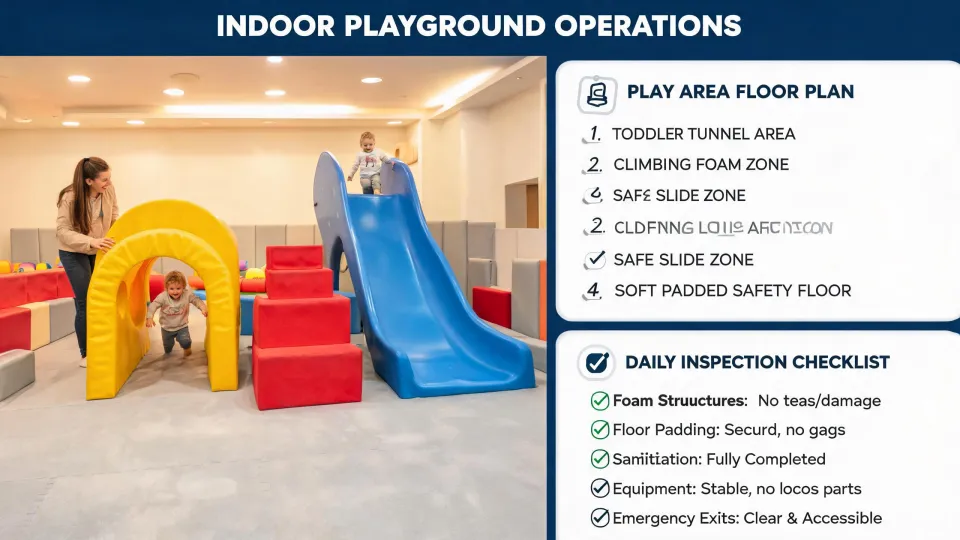
I have mixed feelings about checklists. On one hand, they feel like extra office work. On the other, they catch the stuff that keeps me up at night. Since then, I've expanded ours to 12 points for every new inflatable. The key items are:
- Gate clearance for delivery (both width and height).
- Anchor weight required by the manual vs. what's on site.
- Dedicated circuit rating and distance to outlet.
- Water source and drainage slope for the Hydro Rush.
- ASTM F2376 compliance paperwork in the filing cabinet, not just the email inbox.
- Date, time, and signature for the post-delivery walkthrough.
That last one is the easiest to skip. If a driver drops off an inflatable and you sign the paperwork without looking at the fabric, you've just accepted every scrape and tear as your own. We learned that the cheap way, luckily. One vendor's driver tried to leave before we finished the walkthrough. We held the signature until we checked every seam.
5 minutes of verification beats 5 days of correction.
The takeaway
I'm not going to claim every cheap quote is a trap. The online vendor is probably a perfectly good company. But once you start tracking total cost instead of base price, the picture changes. Base price is the bait. Total cost is the transaction.
As of January 2025, our venue also hosts a Digimon card game night, a Stratego board game tournament, and a monthly 'how do you play card game 31?' session in the party room. The events don't have a lot of overhead. The inflatables do. That's why I spend more time on supplier quotes and safety checklists than on the fun stuff. The fun stuff is fun because the budget side is boring.
There's something satisfying about watching the Hydro Rush go from a shipping crate to a fully running attraction, especially when the spreadsheet says it came in under budget. The best part, honestly, is knowing the next Saturday won't start with a surprise invoice for something I could have caught in five minutes.
Quotes in this story are from March 2024. Blast-zone's current pricing may be different—verify current rates before planning. If you're doing this right, the quote review is the easiest part. The checklists are what actually save you.